
Latest Commercial Aviation Content by Aviation Week & Space Technology
Oct 14, 2013
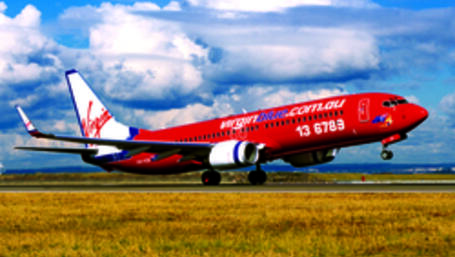
The 737 series is a family of twin-engine, narrowbody commercial transports. Seating capacity varies depending on model, though the most typical two-class configurations are 126 passengers for the 737-700, 162 for the 737-800 and 180 for the 737-900ER. All three models, which are the current production versions, are powered by two CFM56-7 turbofans. The first 737 flew in April 1967 and received FAA certification in December 1967. Through 2012, 7,437 Boeing 737s have rolled off the production lines.
Oct 14, 2013
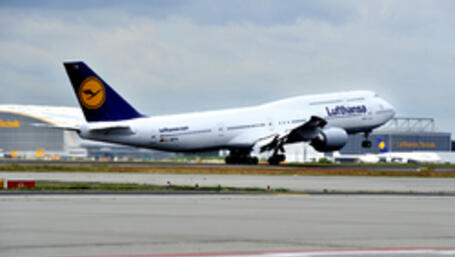
The 747 is an intercontinental widebody commercial transport aircraft powered by four turbofan engines. First flight and certification occurred in 1969. In February 2010, Boeing conducted the maiden flight of the 747-8 series, which includes the 747-8 Intercontinental passenger model and 747-8 Freighter. Both are equipped with four GE GEnx engines rated 66,500 lb. thrust each. The 747-8I is stretched 5.6 meters (18.4 ft.) compared to the 747-400, to accommodate 467 seats in a three-class configuration.
Oct 14, 2013
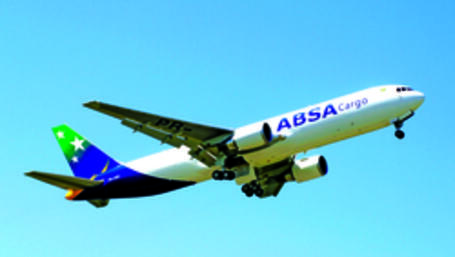
The prototype for this twin-engine, widebody commercial transport was rolled out in August 1981, with first flight the following month; through 2012, Boeing produced 1,108 767s. Only two civil 767 versions are currently in production: the extended range 767-300ER passenger model and -300F freighter. The 767-300ER seats 218 in a three-class layout or up to 350 in one class and has a maximum range of 5,990 nm. The -300ER is available with a choice of GE CF6-80C2 or Pratt & Whitney PW4000 engines. The -300F is powered by the CF6-80C2.
Oct 14, 2013
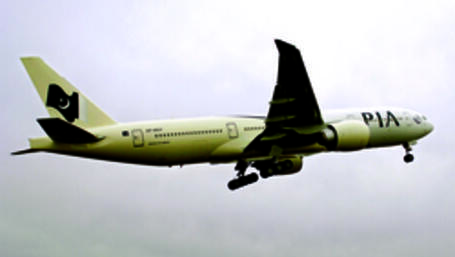
The 777 is a twin-engine, widebody jetliner. First flight occurred in June 1994, followed by FAA/JAA certification in April 1995 (Pratt & Whitney-powered version). Deliveries began in June 1995. The 777-200ER seats 301-440 passengers, and is powered by two PW4000, Trent 800 or GE90 turbofans rated 84,000-95,000 lb. thrust each. Two newer versions are the 777-200LR and -300ER. The -200LR, which seats 301 in three classes, is powered by a pair of 110,100-lb.-thrust GE90-110B1 or 115,300-lb.-thrust GE90-115BL turbofans.
Oct 14, 2013
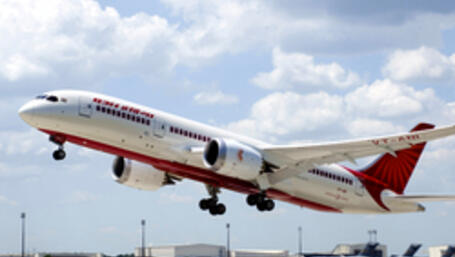
The 787 Dreamliner is a family of twin-engine widebody airliners with three versions. The 787-8 carries 210-250 passengers and has a range of 7,650-8,200 nm. The 787-9, lengthened by six meters (20 ft.), carries 250-290 passengers and has a range of 8,000-8,500 nm. The 787-10 is stretched another 5.5 meters beyond the 787-9. All three models are sold with either two Rolls-Royce Trent 1000 or General Electric GEnx turbofans.
Oct 14, 2013
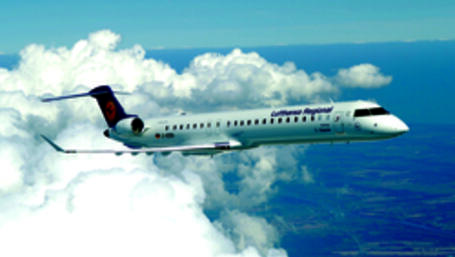
The CRJ series is a family of twin-engine, 44-100-seat regional jets. The initial model was the 50-seat CRJ100, which first flew in May 1991; deliveries began in October 1992. The CRJ100 was replaced by the 50-seat CRJ200, which is powered by a pair of 9,220-lb.-thrust GE CF34-3B1 turbofans. Other variants have included the 44-seat CRJ440, also powered by CF34-3B1s; the 64-78 seat CRJ700, powered by two 13,790-lb.-thrust CF34-8C5 turbofans; and the 86-90-seat CRJ900, powered by two 14,255-lb.-thrust CF34-8C5s.
Oct 14, 2013
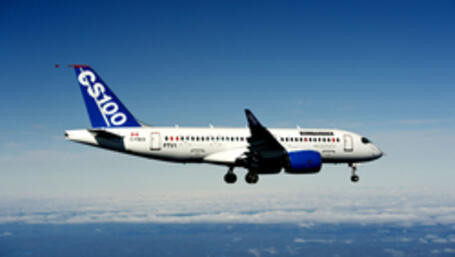
Launched in July 2008, Bombardier's CSeries family comprises two basic models: the CS100, which carries 110 passengers; and the larger CS300 model, which seats 135 in a standard configuration. The aircraft will be powered by two Pratt & Whitney PW1500G geared turbofans producing up to 23,300 lb. thrust each. With an extra-capacity seating option, the CS300 can carry up to 160 passengers. The CS100's first flight occurred in September. The CS100 will compete with the Embraer 190 and 195, while the CS300 will vie against the Boeing 737 and Airbus A319.
Oct 14, 2013
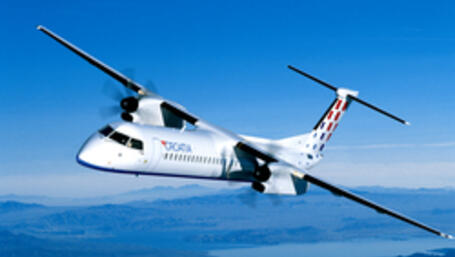
This twin-engine turboprop aircraft family was known as the Dash 8 series. The original Q100 made its first flight in June 1983; first deliveries followed in October 1984. The Q100 carried 37-39 passengers and was equipped with 2,150-shp Pratt & Whitney Canada PW120/121 engines. Other models have been the 37-39-passenger Q200 (with 2,150-shp PW123C/Ds) and the 50-56-seat Q300 (with 2,500-shp PW123Bs). Q100, Q200 and Q300 production has ended. The 68-78-seat Q400 (with 5,071-shp PW150As) remains in production.