
Space Industry Analysis

May 07, 2012
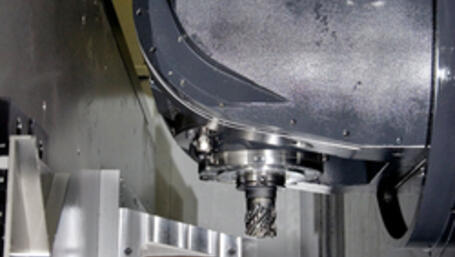
Cutting and drilling of cured composite components during manufacture or repair are a growing challenge as structures become bigger, more complex and costly.

May 07, 2012
Overseas space companies are seeking U.S. partnersOverseas space companies are seeking U.S. partners
May 07, 2012
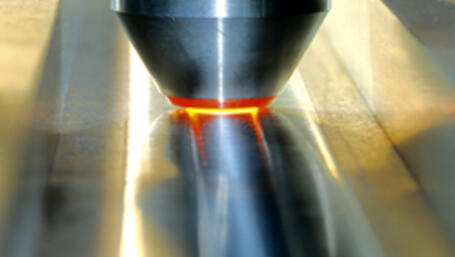
Friction welding fuses metals without melting them and is used in aerospace to join engine disks (rotational welding) or fabricate aircraft and spacecraft structures (friction-stir welding). Now hybrid components produced by linear friction welding of dissimilar metals promise to overcome a key disadvantage of composites: carbon fiber cannot be attached directly to aluminum because of galvanic corrosion, forcing use of higher-cost titanium. But friction welding can allow titanium to be incorporated into the join between aluminum and composite structures.

May 07, 2012
Isogrids are among the lightest and strongest of structures, the lattice pattern of integral stiffening ribs providing extremely high strength-to-weight ratios. Lightweight isogrid panels machined from aluminum plate to produce thin-walled, self-stiffened and damage-tolerant structures are used in launch vehicles and aircraft doors. Advanced grid structures made from composites have been used for components such as payload shrouds, but require time-consuming and costly manual layup. Isogrid Composites Canada Inc.
May 07, 2012
Composites may be replacing metals in aircraft structures, but the use of titanium is increasing both to reduce weight and because of the incompatibility of aluminum and carbon fiber. Boeing's 787 is 50% composite by structural weight, whereas its earlier 777 is only 12%, but a 787 contains almost 90 tons of titanium compared with 55 tons in a larger 777. And titanium can be around 10 times as expensive as aluminum, so pressure is on to reduce costs.

May 07, 2012
Nanotechnology-enabled materials are moving into aerospace. New Hampshire-based Nanocomp Technologies is scaling up production of electrically and thermally conductive yarn, sheet and tape made from long carbon nanotubes (CNT). Spun yarn is being used to replace copper in data cables in aircraft and spacecraft, potentially halving the weight of wiring harnesses. Sheet material was used on NASA's Juno spacecraft, launched in August 2011, to provide electrostatic-discharge protection of attitude-control thruster and main-engine components.
Mar 23, 2020
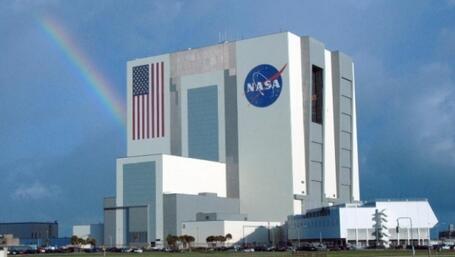
NASA’s Kennedy Space Center in Florida remained open on March 23 to personnel working on Mars 2020, Commercial Crew and Cargo and other mission-critical programs despite its first confirmed case of the coronavirus COVID-19.

Mar 21, 2020
A Russian Soyuz rocket lifted off from Baikonur Cosmodrome in Kazakhstan on March 21 to deliver another 34 satellites into orbit for OneWeb, which is…
Mar 20, 2020
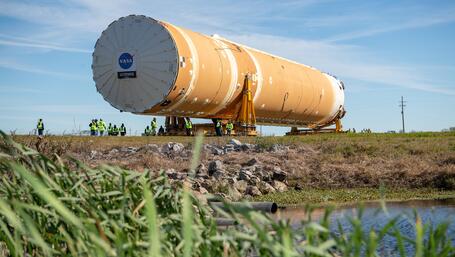
CAPE CANAVERAL - NASA is temporarily halting work on the Space Launch System (SLS) and Orion spacecraft as it closes the Michoud Assembly Facility in…

Mar 19, 2020
Launching the Mars 2020 rover, recently named Perseverance, this summer remains among NASA’s highest priorities, despite agency-wide shutdowns of its facilities due to health concerns over the coronavirus disease COVID-19.
Mar 19, 2020
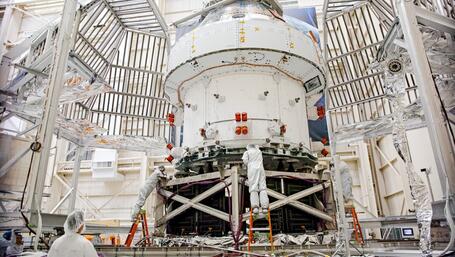
NASA’s Exploration Ground Systems (EGS) program, which provides ground processing and launch facilities for the integrated Space Launch System (SLS) and Orion spacecraft, is in better shape now than when the program was last audited in 2016, but the agency needs to improve cross-program integration and testing, the NASA Office of Inspector General (OIG) said March 19.

Mar 19, 2020
NASA astronaut Chris Cassidy is confident in the well-being of the International Space Station (ISS) and ongoing efforts to soon resume full staffing of the 15-nation orbiting science lab with launches from U.S. soil.

Mar 19, 2020
New research based on the Japan Aerospace Exploration Agency’s Hayabusa 2 asteroid sample return mission has revealed the surface of the asteroid Ryugu is composed of a sand-like, cohesionless material, making it essentially a “rubble pile” in space.

Mar 19, 2020
The mission will mark the first flight of astronauts aboard a U.S. orbital spaceship since space shuttle Atlantis rolled to a stop at the Kennedy Space Center in Florida on July 21, 2011