
Space Industry Analysis
May 21, 2013
A non-toxic propellant and related hardware developed in Sweden for spacecraft attitude control has been tested for NASA’s Goddard Space Flight Center at ATK Defense Group’s Elkton, Md., facility, as the civilian space agency continues its search for “green” propulsion systems.
May 21, 2013
NASA’s third New Frontiers-class mission, the Osiris-Rex asteroid sample return probe, cleared a crucial decision point for development May 15 and is expected to proceed in preparation for launch to the asteroid Bennu in September 2016. If all goes well, Osiris-Rex (Origins-Spectral Interpretation Resources Identification Security Regolith Explorer) will return samples of the asteroid to Earth in 2023.
May 20, 2013
NASA’s Ames Research Center will test a 10-in. high deployment system that can launch as many as 24 nanosats at once during piggyback rides on two Defense Department demonstration missions.
May 20, 2013
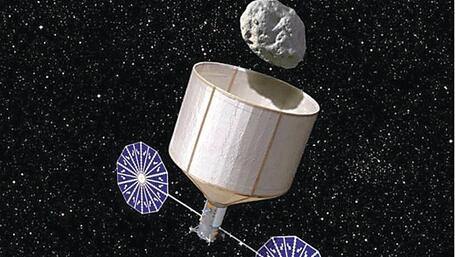
Asteroid exploration featured in NASA’s proposed $17.7 billion budget
May 17, 2013
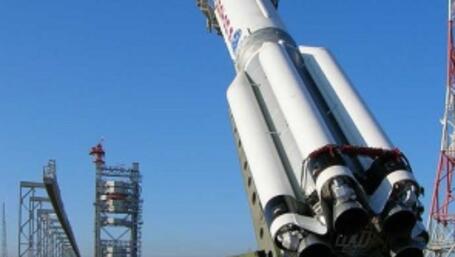
Proton Breeze M launched from Pad 39 at the Baikonur Cosmodrome
May 16, 2013
GPS LAUNCH: The U.S. Air Force used an Atlas V 401 rocket to launch another Global Positioning System timing and navigation satellite into medium Earth orbit on May 15, replenishing the constellation of 24 spacecraft. Liftoff of the 3,600-lb. spacecraft from Cape Canaveral came at the opening of its launch window at 5:38 p.m. EDT. The launch vehicle’s Centaur upper stage ignited for the first of two burns — planned to be bounded by a 3-hr. coast phase — at 5:42 p.m. EDT, following burnout and staging of the Atlas common core booster.
May 16, 2013
Failure of a second reaction control wheel on NASA’s Kepler planet-finding space telescope has ended data collecting with the spacecraft, but not analysis of the “terabytes” of data already captured.
May 16, 2013
LOS ANGELES — Sierra Nevada’s Dream Chaser engineering test article (ETA) is being reassembled at NASA’s Dryden Flight Research Center at Edwards AFB, Calif., in preparation for the start of approach-and-landing flight tests later this summer. Sierra Nevada is competing with the lifting body vehicle against alternative capsule designs developed by Space Exploration Technologies (SpaceX) and Boeing for NASA’s commercial crew program under a $212.5 million Commercial Crew integrated Capability (CCiCap) contract awarded last August.