
Space Industry Analysis
Feb 26, 2013
Orbital Sciences Corp. hopes to launch its new Antares rocket on its first flight at the end of March or early in April, following a successful 29-sec. hot-fire test on its new launch pad at Wallops Flight Facility, Va. Orbital engineers believe they have dealt with a fairing-separation issue that cost NASA two Earth-observing satellites in back-to-back launch failures on the company’s Taurus XL rocket, and don’t expect similar problems with the frangible-joint separation mechanism on the much larger Antares fairing.

Feb 26, 2013
Include Indo-French “Saral” ocean-monitoring satellite

Feb 25, 2013
The Sept. 12 abort occurred about a minute before planned departure
Feb 25, 2013
A new mission directorate at NASA headquarters, set up to give more emphasis to technology development for a wide range of potential missions, will be able to push technology readiness level (TRL) more efficiently than mission-oriented work, according to the engineer selected to head the new organization.
Feb 25, 2013
As if further evidence of its resolving power was needed, NASA’s Kepler planet finder has located a planet circling a star similar to the Sun that is only slightly larger than the Moon. Called Kepler-37b, it is the smallest planet yet observed, smaller than any in the Solar System and one of three circling a star about 210 light years from Earth. None are bigger than Mercury, all orbit their star, Kepler-37, closer than Mercury does to the Sun and all are outside the habitable zone where liquid water might support life.
Feb 25, 2013
The European Space Agency (ESA) has delayed the April launch of its fourth Automated Transfer Vehicle (ATV-4) to the International Space Station (ISS) as it tests a replacement component on the cargo vessel’s Integrated Cargo Carrier (ICC). Previously slated to launch April 18, the Astrium-built ATV-4 was delivered in September to the European Spaceport at Kourou, French Guiana, where it is undergoing final integration and test prior to the mission. It is the fourth of five ATVs slated to launch to the ISS between 2008 and 2014.
Feb 22, 2013
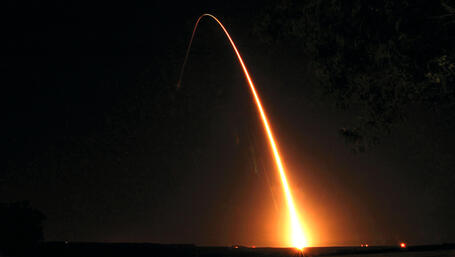
Raises questions about Antares rocket scheduled to fly to ISS
Feb 22, 2013
Often faulted for failing to meet science project cost and schedule targets, NASA seems to be following an effective strategy with the Mars Atmosphere and Volatile Evolution Project, or Maven. The $453 million mission, scheduled for launch Nov. 18, will study climate-influencing changes in the Martian upper atmosphere. If the mission is successful, Maven’s development could become a case study for other science mission projects, according to NASA’s inspector general (IG).